
Unit 2 Test Study Guide: Logic and Proof ౼ Overview
This guide prepares students for a geometry unit test focusing on logic and proof, covering conjectures, conditional statements, deductive reasoning, and geometric proofs.
Logic and proof form the foundation of mathematical reasoning, enabling us to establish the truth of statements through rigorous deduction. This unit introduces students to the core concepts of logical arguments, starting with identifying patterns and formulating conjectures – educated guesses based on observations.
Students will learn to critically evaluate these conjectures, seeking counterexamples to disprove them. The study extends to conditional statements, dissecting their hypothesis and conclusion, and exploring related statements like inverses, converses, and contrapositives.
Ultimately, this introduction equips students with the essential tools for constructing and analyzing proofs in geometry and beyond.
The Importance of Logical Reasoning
Logical reasoning is paramount not only in mathematics but also in everyday life, fostering critical thinking and problem-solving skills. This unit emphasizes the ability to construct valid arguments and discern flawed reasoning. Understanding logical rules, such as modus ponens and modus tollens, allows students to draw sound conclusions from given premises.
Developing these skills enhances a student’s capacity for analytical thought, enabling them to evaluate information objectively and make informed decisions.
Furthermore, logical reasoning is crucial for success in higher-level mathematics and various academic disciplines.

Identifying Patterns and Making Conjectures
Students will learn to observe patterns, formulate conjectures based on evidence, and critically evaluate their validity, utilizing counterexamples when necessary.
What is a Conjecture?
A conjecture is a statement believed to be true based on observed patterns or evidence, but hasn’t been formally proven. It’s essentially an educated guess or a hypothesis. Students will explore how conjectures arise from examining sequences and geometric relationships.
The practice test emphasizes evaluating the truth of these conjectures. Importantly, a single counterexample is sufficient to disprove a conjecture, demonstrating its falsity. This unit focuses on developing the ability to form and test these statements, a foundational skill in mathematical reasoning and proof construction. Recognizing the difference between a proven theorem and an unproven conjecture is crucial.
Forming Conjectures from Patterns
Students will learn to identify patterns in numerical sequences and geometric figures to formulate conjectures. This involves observing relationships, generalizing findings, and expressing them as testable statements. The unit’s notes and assignments specifically address this skill, encouraging students to look for repeating elements or predictable changes.
The practice test includes questions designed to assess this ability. Successfully forming conjectures requires careful observation and logical thinking. It’s a vital step towards developing deductive reasoning skills and constructing formal proofs. Recognizing underlying principles within patterns is key to mathematical discovery and problem-solving.
Counterexamples and Disproving Conjectures
A crucial aspect of logical reasoning is understanding how to disprove a conjecture. Students will learn that a single counterexample – an instance where the conjecture is false – is sufficient to invalidate it. The unit’s materials emphasize the importance of actively seeking such examples to test the validity of proposed statements.
The practice test directly assesses this skill, requiring students to identify or create counterexamples. This process reinforces the understanding that a conjecture, even if observed to be true in many cases, isn’t necessarily universally true. Mastering this concept is fundamental to rigorous mathematical thinking and proof construction.
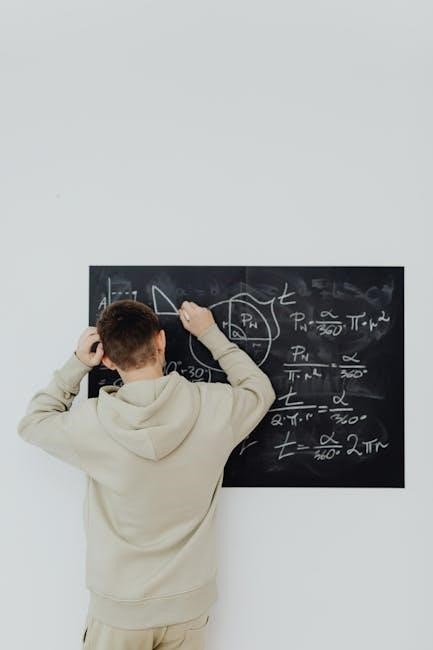
Conditional Statements
This section explores “if-then” statements, dissecting their hypothesis and conclusion, and examining related forms like the inverse, converse, and contrapositive.
Understanding “If-Then” Statements
Conditional statements are fundamental to logical reasoning, structured as “if p, then q,” where ‘p’ represents the hypothesis and ‘q’ the conclusion. Recognizing this structure is crucial for analyzing arguments and constructing valid proofs. Students must learn to identify these components within various statements and understand how the truth value of one affects the other.
The test will assess your ability to accurately deconstruct these statements, pinpointing the precise conditions under which the conclusion logically follows. Mastering this concept forms the bedrock for more complex logical operations and geometric deductions, ensuring a solid foundation for future mathematical exploration.
Hypothesis and Conclusion
Within an “if-then” statement, the hypothesis is the initial condition – the ‘if’ part – stating what must be true. Conversely, the conclusion is the result – the ‘then’ part – which logically follows if the hypothesis holds. Accurately identifying each component is vital for evaluating the statement’s validity and constructing logical arguments.
The unit 2 test will specifically examine your ability to separate these elements in diverse scenarios. Understanding this distinction allows for the creation of inverse, converse, and contrapositive statements, deepening comprehension of logical relationships and strengthening proof-writing skills. Precise identification is key to success!
Inverse, Converse, and Contrapositive
Understanding the transformations of conditional statements is crucial. The inverse negates both the hypothesis and conclusion. The converse switches the hypothesis and conclusion. The contrapositive negates both, and switches them. Importantly, a conditional statement and its contrapositive are logically equivalent – always both true or both false.
The unit 2 test will assess your ability to correctly form each of these related statements. Knowing that the converse and inverse aren’t necessarily true, even if the original statement is, is vital. Mastering these concepts strengthens logical reasoning and proof construction skills, ensuring test success.
Logical Reasoning and Deductive Reasoning
Deductive reasoning uses established facts to reach a guaranteed conclusion, unlike inductive reasoning’s probable conclusions. Mastering rules like modus ponens and modus tollens is key.
Deductive vs. Inductive Reasoning
Deductive reasoning begins with general statements (premises) to reach a specific, certain conclusion. If the premises are true, the conclusion must be true; it’s logically guaranteed. Conversely, inductive reasoning starts with specific observations and attempts to form a general conclusion. However, inductive reasoning doesn’t guarantee the conclusion, only makes it probable.
For example, observing many swans are white (inductive) doesn’t prove all swans are white. Discovering a black swan disproves the generalization. Deductive reasoning, using a proven theorem, allows for definitive proof. Understanding this distinction is crucial for evaluating arguments and constructing valid proofs, as the unit test will assess.
Rules of Inference (Modus Ponens, Modus Tollens)
Modus Ponens affirms the antecedent: If P, then Q. P is true, therefore Q is true. For instance, “If it rains, the ground is wet. It is raining, therefore the ground is wet;” Modus Tollens denies the consequent: If P, then Q. Q is false, therefore P is false. “If it rains, the ground is wet. The ground is not wet, therefore it did not rain.”
These rules are fundamental to deductive reasoning and constructing logical arguments. The unit test will likely require applying these rules to determine the validity of arguments and to complete proofs. Mastering these inference rules is essential for demonstrating a strong understanding of logical structure.
Applying Logical Rules to Proofs
Successfully constructing proofs demands a strategic application of established logical rules, like Modus Ponens and Modus Tollens. Begin with given information and valid definitions, then systematically deduce subsequent statements. Each step must be justified with a known theorem, postulate, or definition.
The unit test will assess your ability to chain these logical steps together to reach the desired ‘prove’ statement. Expect questions requiring you to identify missing justifications or to construct entire proofs from scratch. Practice recognizing patterns and applying appropriate rules is key to success.

Truth Tables
Truth tables systematically evaluate statement validity by examining all possible truth value combinations, determining if a statement is always true or false.
Constructing Truth Tables
Creating truth tables involves listing all possible combinations of truth values – true (T) or false (F) – for each statement variable. For ‘n’ variables, there are 2n possible combinations.
Each row represents a unique combination, and columns are dedicated to each variable and the resulting compound statement. Carefully consider the logical connectives (AND, OR, NOT, conditional, biconditional) to determine the truth value of the compound statement for each row.
Accuracy is crucial; a single error can invalidate the entire table. Practice constructing tables for various statements to master this fundamental skill in logical analysis.
Evaluating the Truth Value of Statements
Determining truth values is central to logical reasoning. Once a truth table is constructed, evaluating a statement’s truthfulness becomes straightforward. Examine the final column representing the compound statement. If all rows yield a ‘True’ (T) value, the statement is a tautology – always true.
Conversely, if all rows show ‘False’ (F), it’s a contradiction – always false. If the truth values vary, the statement is a contingency. Understanding these classifications is vital for assessing the validity of arguments and proofs.
Carefully analyze each connective’s impact on the overall truth value.
Using Truth Tables to Determine Validity
Truth tables are powerful tools for assessing the validity of arguments. An argument is valid if, and only if, whenever the premises are true, the conclusion is also true. Construct a truth table including all premises and the conclusion.
Identify rows where all premises are true. If, in those same rows, the conclusion is also true, the argument is valid. If even one row shows true premises with a false conclusion, the argument is invalid.
This method provides a definitive test of logical structure.
Geometric Proofs: Basics
Geometric proofs utilize logical reasoning, starting with given information to prove a statement. They require valid reasons—definitions, postulates, or previously proven theorems—for each step.
The Structure of a Geometric Proof
A geometric proof is a series of logical statements, each building upon the previous one, to establish the truth of a given conclusion. It begins with clearly stated “Given” information – the known facts or assumptions. Following this is the “Prove” statement, outlining what needs to be demonstrated.
Each step in the proof consists of a statement and a corresponding “Reason” justifying that statement. Reasons can include definitions, postulates, previously proven theorems, or logical deductions. Proofs are typically organized in a two-column format, with statements on the left and reasons on the right, ensuring clarity and logical flow. Mastering this structure is crucial for success.
Given and Prove Statements
Geometric proofs always start with “Given” statements, which are the facts we assume to be true at the beginning. These are the knowns, the starting point of our logical argument. Following the “Given” is the “Prove” statement, which clearly defines the conclusion we aim to reach through a series of logical steps.
Understanding both components is vital. The “Given” provides the foundation, while the “Prove” directs the proof’s path. For example, a “Given” might state “If two angles in a triangle…”, and the “Prove” might be “.;.triangle.” Correctly identifying these sets the stage for a successful proof.
Valid Reasons for Justification
Each step within a geometric proof requires a valid justification, explaining why that step is logically correct. Acceptable reasons include definitions (like vertical angles are congruent), postulates (basic assumptions), previously proven theorems, or rules of inference like Modus Ponens.
Simply stating a step isn’t enough; you must link it to established mathematical principles. Common justifications involve angle relationships (supplementary, complementary), triangle properties, or congruence postulates. Using incorrect or insufficient justifications will invalidate the proof, so precision is key.
Angle Relationships and Proofs
Mastering angle relationships—vertical, supplementary, complementary, and bisectors—is crucial for constructing geometric proofs and demonstrating logical reasoning skills effectively.
Vertical Angles
Vertical angles are formed when two lines intersect, creating pairs of opposite angles that are always congruent. Understanding this fundamental concept is vital for constructing proofs in geometry. Students must be able to identify vertical angle pairs within diagrams and articulate the theorem stating their congruence.
The test will likely assess your ability to apply this theorem as a justification in a two-column proof. Remember, a clear understanding of vertical angles simplifies many geometric problem-solving scenarios. Knowing that they are congruent “if and only if” they are vertical angles is key!
Supplementary and Complementary Angles
Supplementary angles are two angles whose measures add up to 180 degrees, while complementary angles sum to 90 degrees. Mastering these definitions is crucial for solving angle-related problems and constructing logical proofs. The unit 2 test will assess your ability to identify these angle pairs and apply their properties.
Expect questions requiring you to calculate unknown angle measures given supplementary or complementary relationships. Remember, angles are supplementary “if and only if” their sum is 180 degrees. Practice using these definitions as justifications within two-column proofs to demonstrate logical reasoning.
Angle Bisectors and Proofs
An angle bisector divides an angle into two congruent angles. Understanding this definition is vital for constructing proofs involving angle relationships. The unit 2 test will likely include problems where you must prove statements about angle bisectors, utilizing definitions and previously established theorems.
Be prepared to use angle addition postulate and the definition of congruence to justify steps in your proofs. Remember that if a ray bisects an angle, the two resulting angles are equal in measure. Practice writing clear, concise proofs demonstrating your logical reasoning skills when dealing with angle bisectors.

Triangle Properties and Proofs
Mastering triangle theorems—sum, isosceles, and congruence—is key. The unit 2 test assesses your ability to apply these properties within geometric proofs effectively.
Triangle Sum Theorem
Understanding the Triangle Sum Theorem is fundamental for proof construction. This theorem states that the interior angles of any triangle always add up to 180 degrees. Students must be able to apply this theorem to solve for missing angles within a triangle and, crucially, to justify steps within a geometric proof.
The unit 2 test will likely present problems requiring you to demonstrate this understanding. Expect questions where you’re given two angle measures and asked to calculate the third, or scenarios where you need to explain why the angles sum to 180 degrees. Be prepared to use algebraic reasoning alongside the theorem to solve for unknown variables representing angle measures.
Isosceles Triangle Theorem

The Isosceles Triangle Theorem establishes a key relationship between sides and angles. It states that if a triangle has two congruent sides (an isosceles triangle), then the angles opposite those sides are also congruent. Conversely, if two angles in a triangle are congruent, the sides opposite them are congruent.
Expect test questions requiring you to apply this theorem to find missing angle measures or side lengths in isosceles triangles. Proofs will frequently involve using the theorem as a justification. Understanding the converse is equally important; recognizing when congruent angles imply congruent sides is crucial for problem-solving and proof construction within the unit 2 assessment.
Congruent Triangles and Proofs
Congruent triangles are central to geometric proofs, demanding a solid grasp of congruence postulates (SSS, SAS, ASA, AAS, HL). The unit 2 test will assess your ability to identify congruent triangles and justify their congruence using these postulates. Expect problems requiring you to write two-column proofs demonstrating triangle congruence.
Mastering corresponding parts of congruent triangles being congruent (CPCTC) is vital. You’ll need to apply CPCTC after establishing triangle congruence to prove additional relationships. Practice recognizing sufficient conditions for congruence and constructing logical arguments to support your conclusions within the proofs.

Unit 2 Test Preparation
Prepare by reviewing key definitions, theorems, and practicing problems, including sample questions and strategies for tackling proof-based questions effectively.
Reviewing Key Definitions and Theorems
Focus on core concepts like conjectures – educated guesses based on patterns – and understand how to disprove them with counterexamples. Master conditional statements, identifying the hypothesis and conclusion.
Review the inverse, converse, and contrapositive forms, and their logical relationships.
Differentiate between deductive and inductive reasoning, and practice applying rules of inference like modus ponens and modus tollens.
Crucially, revisit angle relationships – vertical, supplementary, complementary – and triangle theorems like the Triangle Sum and Isosceles Triangle Theorems.
Solidify understanding of congruent triangles and their properties for successful proof construction.
Practice Problems and Sample Questions
Engage with problems identifying patterns and formulating conjectures, then testing their validity with counterexamples. Practice constructing conditional statements and determining their inverse, converse, and contrapositive.
Work through deductive reasoning scenarios, applying modus ponens and modus tollens.
Complete truth tables to evaluate statement validity. Tackle geometric proofs involving angle relationships (vertical, supplementary) and triangle properties.
Review sample test questions focusing on given/prove statements and valid justifications.
Utilize practice tests, like those available online, to simulate the test environment and assess your understanding.
Strategies for Solving Proof Problems
Begin by carefully reading the ‘given’ and ‘prove’ statements, visualizing the geometric figure. Develop a plan, working backward from the ‘prove’ statement to identify necessary steps. Utilize known definitions, postulates, and theorems as justifications.
Draw diagrams and label them clearly.
Break down complex proofs into smaller, manageable steps.
Practice writing logical arguments, ensuring each step follows from the previous one.
Review completed proofs to identify potential errors and alternative approaches. Remember to clearly state each reason for justification.